

The Greeks in Sicily: The History of Magna Graecia in Sicily
In This Article
Hello friends! Today I'm taking you back in time, way back – we're talking almost 3000 years ago, when the Greeks decided that Sicily was too beautiful to pass up. 😎
I'll tell you right away: this story has fascinated me since I was a kid and my grandfather used to take me to see the temples of Agrigento. "See – he would say – the Greeks built these, and they're still standing after all this time. Try building something that lasts this long!" The old man was right, as always.
But let's take it step by step, because the history of the Greeks in Sicily is long and full of plot twists worthy of a Netflix series.
Why Did the Greeks Come to Sicily?
Now, put yourself in the shoes of a Greek from the 8th century BC. You're in your polis, maybe in Corinth or Chalcis, and you have a problem: there are too many of you and not enough land. The Greek mountains are beautiful to look at, but try growing wheat on those rocks!
So what do you do? You take a ship and go seek your fortune elsewhere. A bit like our grandfathers who emigrated to America, except instead of crossing the Atlantic, the Greeks crossed the Mediterranean.
Sicily was perfect: mild climate, fertile lands, strategic position for trade. Greek sailors already knew it because they passed through for commerce, and they had noticed that life here was good. Literally, since they then built all those temples!

Map of Greek colonization in Sicily (8th-5th century BC)
It should be said that Sicily wasn't empty when they arrived. There were already the Sicani in the western part, the Siculi in the east (from whom the name Sicily derives, imagine that), and the Elymians in the Trapani area. With some of these peoples the Greeks got along fairly well, with others... well, let's say things got complicated.
If you want to better understand what was here before the Greeks, check out our article on the prehistory of Sicily. It's fascinating stuff, I assure you!
The First Colonies: From Naxos to Syracuse
The first Greek settlement in Sicily was Naxos, founded in 734 BC by the Chalcidians. Do you know where it is? Right below Taormina, in present-day Giardini Naxos. Next time you're on the beach at Giardini sunbathing, think that under your feet lies the first Greek colony in Sicily. Quite something, isn't it?
But Naxos was just the appetizer. The following year, in 733 BC, the Corinthians founded Syracuse. And here the story changes completely, because Syracuse wasn't just any colony – it was destined to become one of the most powerful cities in the Mediterranean.
In the following years, colonies sprang up like mushrooms after rain. Here are the main ones with their founding dates:
| Colony | Year Founded | Founders | Location |
|---|---|---|---|
| Naxos | 734 BC | Chalcidians | East coast (Giardini Naxos) |
| Syracuse | 733 BC | Corinthians | Southeast coast |
| Megara Hyblaea | 728 BC | Megarians | East coast (Augusta) |
| Gela | 688 BC | Rhodians and Cretans | South coast |
| Selinunte | 650 BC | Colonists from Megara Hyblaea | Southwest coast |
| Akragas (Agrigento) | 580 BC | Colonists from Gela | South coast |
Each city had its own history, its temples, its rivalries. Because yes, the Greeks of Sicily didn't always get along with each other. In fact, they spent a lot of time making war on one another. A bit like our medieval communes, centuries later.
Syracuse: When We Were a Superpower
Okay, let's talk about Syracuse, which deserves its own chapter. This city was something incredible – at its peak it was larger and more powerful than Athens. Yes, you read that right: more powerful than Athens!

The magnificent Greek Theatre of Syracuse, still used today for classical performances
The location was perfect: the island of Ortygia connected to the mainland, two natural harbors, abundant fresh water. The Corinthians who founded it knew what they were doing.
The moment of absolute glory? In 413 BC, when the Athenians decided to conquer Syracuse. They sent an enormous fleet, the largest military expedition in their history. And do you know how it ended? Badly, very badly for the Athenians. The Syracusans crushed them, captured thousands of prisoners and put them to work in the stone quarries – the famous Latomie that you can still visit today.
That defeat was the beginning of the end for Athens. Think about it: the history of classical Greece was changed here, in Sicily, by us.

Archimedes of Syracuse, the greatest scientist of antiquity
And then there was Archimedes. The greatest scientist of antiquity was Syracusan! The one who discovered the principle of the lever, the one who ran naked through the streets shouting "Eureka!", the one who invented war machines so deadly that the Romans took two years to conquer Syracuse despite being far more numerous.
When they finally entered the city in 212 BC, a Roman soldier killed Archimedes – it seems the old scientist was doing calculations in the sand and had responded rudely to the soldier who disturbed him. What a character!
Agrigento and Those Amazing Temples
If Syracuse was the military power, Akragas (today's Agrigento) was the city of money and art. The poet Pindar called it "the most beautiful city of mortals." And he wasn't exaggerating.

The Temple of Concordia, one of the best preserved in the world
The Valley of the Temples is something that leaves you speechless, even after you've seen it ten times. I go there often and every time I stop to look at the Temple of Concordia thinking: how did they do it? How did they build something so perfect, so harmonious, 2500 years ago, that's still standing?
The beautiful thing is that what we see today is only part of what was there. The valley had at least a dozen enormous temples, plus sanctuaries, plus public buildings. It was like the Las Vegas of antiquity, but with more class!
The Agrigentines were famous for being extremely rich and for flaunting this wealth. It's said they lived as if they were going to die tomorrow and built as if they were going to live forever. A very Sicilian attitude, if you think about it!
There's a story that always makes me laugh: the philosopher Empedocles (also from Agrigento) said that the inhabitants of Akragas "build as if they were never going to die and eat as if they were going to die tomorrow." Nothing has changed in 2500 years, trust me!
The most famous tyrant of Agrigento was Phalaris, who had a bronze bull built where he roasted his enemies. Horror movie stuff. Fortunately, in the end he met the same fate inside his own bull – karma, they would say today.
Other Greek Cities in Sicily
There weren't just Syracuse and Agrigento, you know. Greek Sicily was full of important cities.

The majestic ruins of Selinunte, the largest archaeological park in Europe
Selinunte, on the southwest coast, had enormous temples – some of the largest ever built by the Greeks. Today it's a spectacular archaeological park, although the temples have mostly collapsed due to earthquakes. If you go there, be prepared to walk a lot because the site is vast.
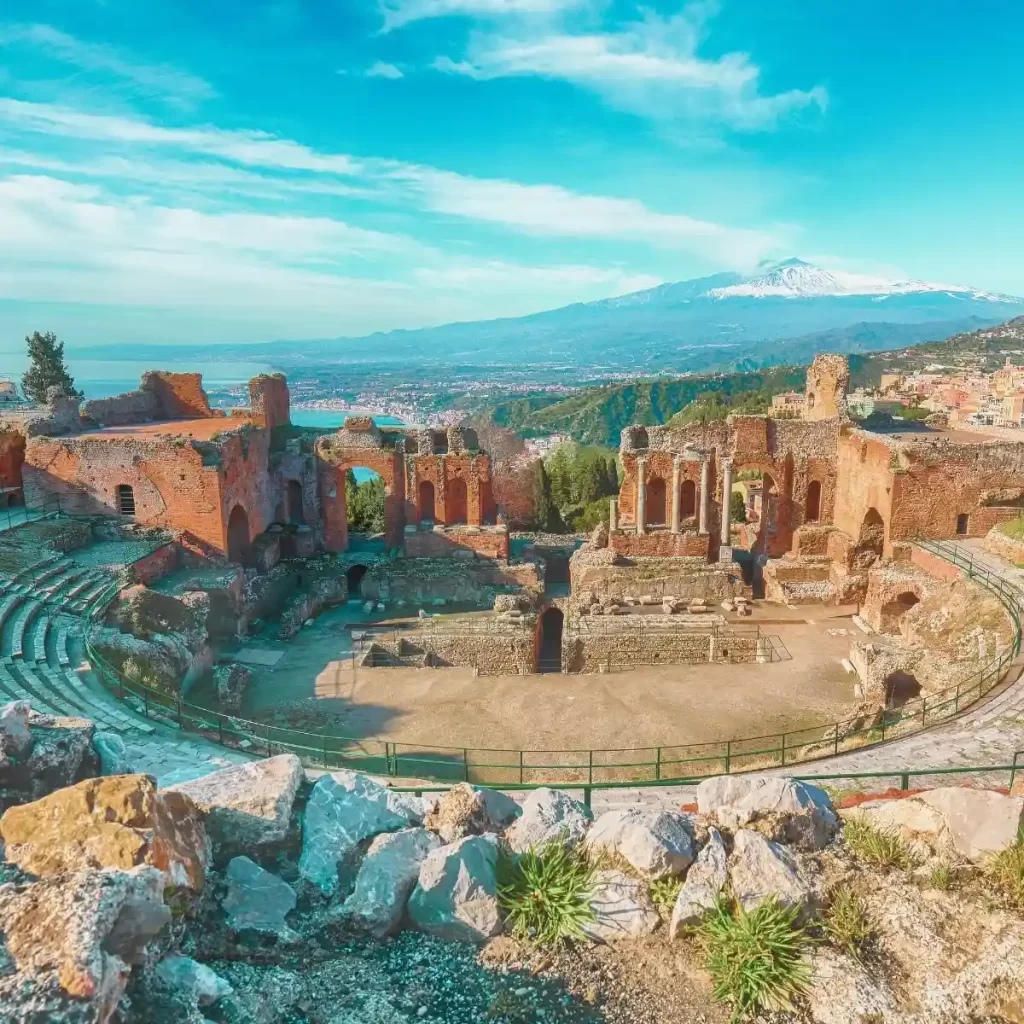
The Greco-Roman Theatre of Taormina with the spectacular view of Etna
Taormina (ancient Tauromenion) you all know for its Greco-Roman theatre, the one with the view of Etna and the sea. Well, that theatre was built by the Greeks, although the Romans later modified it. The panoramic position is no accident: the Greeks knew how to choose the right places!
Segesta, in the Trapani area, is a special case because it wasn't a Greek city but Elymian. However, the Elymians were so influenced by Greek culture that they built themselves a perfect Doric temple and a theatre that looks like it came straight from Greece. It's one of the most evocative places in Sicily, believe me. The temple is in the middle of the countryside, with nothing around it, and when you go there at sunset it feels like you've traveled back in time.
Morgantina, in the interior near Enna, was a rich and important city. Excavations have unearthed beautiful mosaics and objects that are now scattered in museums around the world (we've even gotten some back after legal battles that lasted decades).
The Tyrants: Bad But Not Stupid
Now, when we hear the word "tyrant" we immediately think of bad and cruel people. And okay, some of them really were. But in ancient Greece, a tyrant was simply someone who took power without being from a noble family. Some were terrible rulers, others were among the most enlightened of their time.
Gelon of Syracuse, for example. He took power in 485 BC and transformed Syracuse into the most powerful city in Sicily. In 480 BC he defeated the Carthaginians at the Battle of Himera – a victory so important that the Greeks compared it to the Battle of Salamis against the Persians. Basically, Sicily saved the Greek West from Carthaginian invasion. Keep that in mind, because we often forget it!
Hiero I, Gelon's brother, was an amazing patron. The greatest poets and thinkers of the era came to his court. Pindar, Aeschylus, Simonides... they all passed through Syracuse. It was like the Hollywood of antiquity, but with more culture!
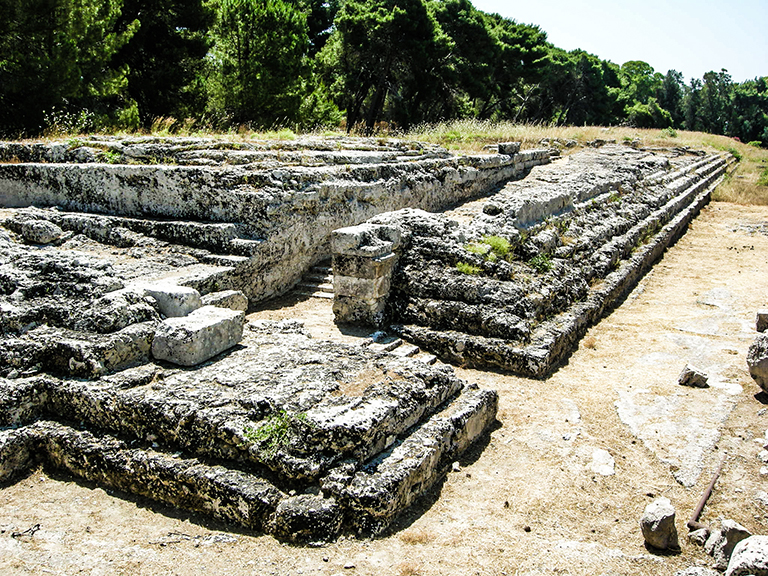
The Altar of Hiero II in Syracuse, the largest sacrificial altar in the Greek world
Dionysius I was perhaps the most powerful of all. He ruled for almost 40 years and transformed Syracuse into an empire that controlled much of Sicily and southern Italy. He was paranoid (he slept in a room surrounded by a moat, for fear of being assassinated), but also brilliant. He built the walls of Syracuse, the longest in the Greek world, and invented the catapult. Yes, the catapult was invented here, in Syracuse!
Agathocles did something even more audacious: instead of waiting for the Carthaginians to attack Sicily, he went to attack Carthage! He landed in Africa with his army and almost conquered the city. In the end he didn't succeed, but the courage of that enterprise has remained in history.
Hiero II was the last great Syracusan tyrant, the one who reigned in the time of Archimedes. He was a faithful ally of Rome and ruled for over 50 years in peace and prosperity. When he died in 215 BC, Syracuse made the mistake of siding with Carthage against Rome. We all know how that ended.
What the Greeks Left Us
The Greeks didn't just leave us temples and theatres. They left us a way of thinking, of living, of seeing the world.

Greek red-figure ceramic, typical artistic production of Magna Graecia
Philosophy, for starters. Empedocles of Agrigento theorized the four elements (earth, water, air, fire) and the evolution of species – 2400 years before Darwin! Archimedes of Syracuse laid the foundations of physics and mathematics. Gorgias of Leontini (today's Lentini) was one of the greatest rhetoricians of antiquity.
Greek theatre was born in Athens, but in Sicily it reached great heights. Aeschylus, the father of tragedy, came to Sicily several times and died right here, in Gela. It's said he died when an eagle dropped a turtle on his head. An absurd death for such a great man, but history is sometimes strange.
Greek architecture in Sicily developed its own characteristics. Sicilian temples are often larger and more decorated than those in Greece proper. It was a way of demonstrating that the colonies were not inferior to the motherland. Quite the opposite!
And then there's ceramics. Greek vases produced in Sicily are beautiful, with mythological and everyday life scenes. Many are in the museums of Palermo and Syracuse, and they're worth seeing.
But perhaps the most important thing they left us is the very idea of the city, of community, of participation in public life. The Greek agora, the square where people discussed and decided together, is the ancestor of our Italian piazzas. That way of being together, discussing, even arguing, but always as a community – that comes from the Greeks.
Where to See All This Today
Okay, enough history, let's talk practical matters. Where can you experience this Greek heritage firsthand?

The Temple of Concordia illuminated at night: a magical experience
The Valley of the Temples in Agrigento is obviously the number one place. It's a UNESCO World Heritage Site and I recommend it at sunset, when the temples turn golden and it feels like being in a painting. The Temple of Concordia is one of the best preserved in the world – more intact even than the Parthenon!
The Archaeological Park of Syracuse includes the Greek theatre (still used for classical performances in summer), the Latomie del Paradiso with the Ear of Dionysius, and the Roman amphitheatre. If you go in May-June, try to see a Greek tragedy at the theatre – it's an unforgettable experience.
The Paolo Orsi Archaeological Museum in Syracuse is probably the most important archaeological museum in Sicily. It has everything: from prehistory to Greeks to Romans. Give yourself plenty of time because it's huge.
Selinunte is the largest archaeological park in Europe. The temples have largely collapsed, but the dimensions are still impressive. And the beach nearby is beautiful, so you can combine culture and sea.
Segesta has the advantage of being less crowded and more evocative. The temple and theatre are in a spectacular panoramic position.
Taormina you already know, but the Greco-Roman theatre is still worth a visit. That view of Etna and the sea is unique in the world.
If you're interested in the history of Sicily, check out our articles on the Romans in Sicily and the Byzantines – history continues!
The History of Sicily
Frequently Asked Questions About the Greeks in Sicily
Did the Greeks colonize or conquer Sicily?
Great question! Technically we talk about "colonization," but not in the modern sense. The Greeks founded new cities, often in agreement with local populations, sometimes not. They didn't conquer an island that was already politically organized – they created something new. Over time, local populations (Siculi, Sicani, Elymians) mixed with the Greeks, adopting their culture. It was more a fusion than a true conquest.
Why is it called Magna Graecia?
The term "Magna Graecia" (Great Greece) referred to the Greek colonies of southern Italy and Sicily. It was "magna" because these colonies became so rich and powerful that they surpassed in splendor many cities in Greece proper. It wasn't an official name, but a way of saying "life is better here than in Greece!"
How long did Greek rule in Sicily last?
From the founding of Naxos in 734 BC to the Roman conquest of Syracuse in 212 BC, about 500 years passed. But Greek influence continued even after: the Romans admired Greek culture and kept it alive. In a sense, the Greek heritage is still with us today.
What was the most important Greek city in Sicily?
Syracuse, without a doubt. At its peak it was one of the largest and most powerful cities in the Mediterranean world. But Agrigento, Selinunte and Gela were also very important cities. It was a bit like Italy's medieval communes: many powerful cities competing with each other.
What did the Greeks of Sicily eat?
Wheat, olive oil, wine, cheese, fish, legumes, fruit. Sound familiar? The Mediterranean diet that everyone envies today comes straight from there! The Greeks of Sicily were famous for their good cooking – Mithaecus of Syracuse wrote one of the first recipe books in history. We Sicilians have always been foodies!
Can I see Greek theatre performances in Sicily?
Yes! Every year, between May and June, classical performances organized by INDA are held at the Greek theatre of Syracuse. Greek tragedies and comedies staged in the same theatre where they were performed 2500 years ago. It's a unique experience, I highly recommend it!
Conclusion
The history of the Greeks in Sicily is one of those stories that makes you understand how important we Sicilians have been in world history. We weren't a peripheral colony – we were the center of the Mediterranean, the place where the fates of empires were decided.
And the beautiful thing is that all of this is still there, visible, touchable. The temples of Agrigento, the theatre of Syracuse, the ruins of Selinunte – they're all there just waiting for you to visit them.
Next time you visit one of these places, stop for a moment. Close your eyes and try to imagine what it was like 2500 years ago. The priests climbing the temple steps, the actors performing Aeschylus in the theatre, the philosophers debating in the agora. All of this happened here, in our Sicily.
And if you want to continue this journey through Sicilian history, I'll be waiting for you with the article on the Romans in Sicily. Because history never stops, and neither do we!
Until next time, friends! 🏛️